Search for property investment in East Bengaluru and you will find two kinds of answer: a slogan, or a spreadsheet. Neither helps very much. The useful answer is narrower. Which belt, at what price, held for how long, and what has to happen for the plan to work. East Bengaluru is not one property market; it is several corridors that behave differently, and those differences matter more than any single view about the city. If you want the short verdict first, read is East Bangalore good for investment, and for how value growth actually happens, Bangalore property price appreciation.
Why East Bengaluru behaves differently
East Bengaluru and its southern extension are established IT-led residential corridors. That one fact does most of the explanatory work. Large office and industrial employers create a tenant pool that renews itself, which supports rents and shortens the gaps between tenancies, and the same employers create a steady stream of end users who will pay to live close to work.
The consequence is that this is a mature market rather than a speculative one. Prices tend to move with employment, road access and delivered infrastructure rather than with sentiment, and the return on offer is usually rent while you hold plus gradual capital growth. A buyer who wants a sharp discount to some future price is generally looking in the wrong place, and a buyer who wants to be paid for patience is in the right one.
It is also worth naming what everyone in the corridor is competing for: the same limited supply of well-located land. That is why the newest large-format projects cluster on the southern edge of the city rather than in its centre.
The three belts buyers actually compare
| Belt | Character | Who buys there | What to watch |
|---|---|---|---|
| Whitefield and the eastern Outer Ring Road | Mature office-led district, densely built and well served | End users who work nearby, long-hold investors | Traffic, older buildings, redevelopment potential |
| Sarjapur Road itself | Established residential corridor with schools and hospitals along it | Families working in the corridor | Entry price, and how much new supply is coming |
| Sarjapur–Attibele Road (SH-35) | Southern growth edge with more land and more planned infrastructure | Buyers trading a longer commute for space and a lower entry point | Whether the proposals are ever delivered |
Most of the new large-format supply sits in the third belt, because that is where land is still available at a workable price. It is also the belt where a buyer is underwriting the future rather than the present. That is the whole risk and the whole opportunity at once.
What actually drives values on this side of the city
Four things, in rough order of how reliably they hold up.
- Employment within a commutable distance. Wipro Kodathi, Electronic City and HSR Layout sit within an indicative 20–35 minutes of the Sarjapur–Attibele stretch; the Attibele industrial area and Narayana Institute at Bommasandra within an indicative 10–20 minutes. Employers of that size anchor housing demand for years rather than quarters.
- Road access. SH-35 links the Sarjapur–Attibele Road with the Bengaluru Business Corridor and the Satellite Town Ring Road, which matters for anyone whose work involves moving people or goods rather than a fixed desk.
- Social infrastructure. Azim Premji University and Indus International School sit within an indicative 0–10 minutes, and Manipal Hospital on Sarjapur Road within 10–20. Schools and hospitals are what convert a corridor into a neighbourhood that families settle into rather than pass through.
- The product itself. Land size, homes per floor, orientation, view and the developer's delivery record decide whether one particular home holds its value better than another a kilometre away.
What does not drive value is a proposal on a slide. Metro lines, industrial townships and stadiums move prices when they are built and occupied, not when they are announced. Treat an announcement as a reason to look more closely, never as a reason to pay more today.
Infrastructure that is still only a proposal
The projects most often quoted to buyers in this corridor are a proposed 72 km metro corridor with a planned extension through Attibele, Hosur and SIPCOT, a proposed 10.5 km Yellow Line extension from Bommasandra to Attibele, a planned 647-acre KIADB SWIFT City, and an upcoming 80,000-seat international cricket stadium at Surya City. All of them depend on government agencies and on those agencies' own approvals, funding and construction schedules. None is controlled by a developer, and none should be treated as though it already exists.
That does not make them irrelevant. It means they belong in the upside column of your calculation rather than the base case. The two articles that unpack them are SWIFT City Bangalore investment and metro connectivity and property prices in Bangalore.
A worked example on SH-35, and who buys it back
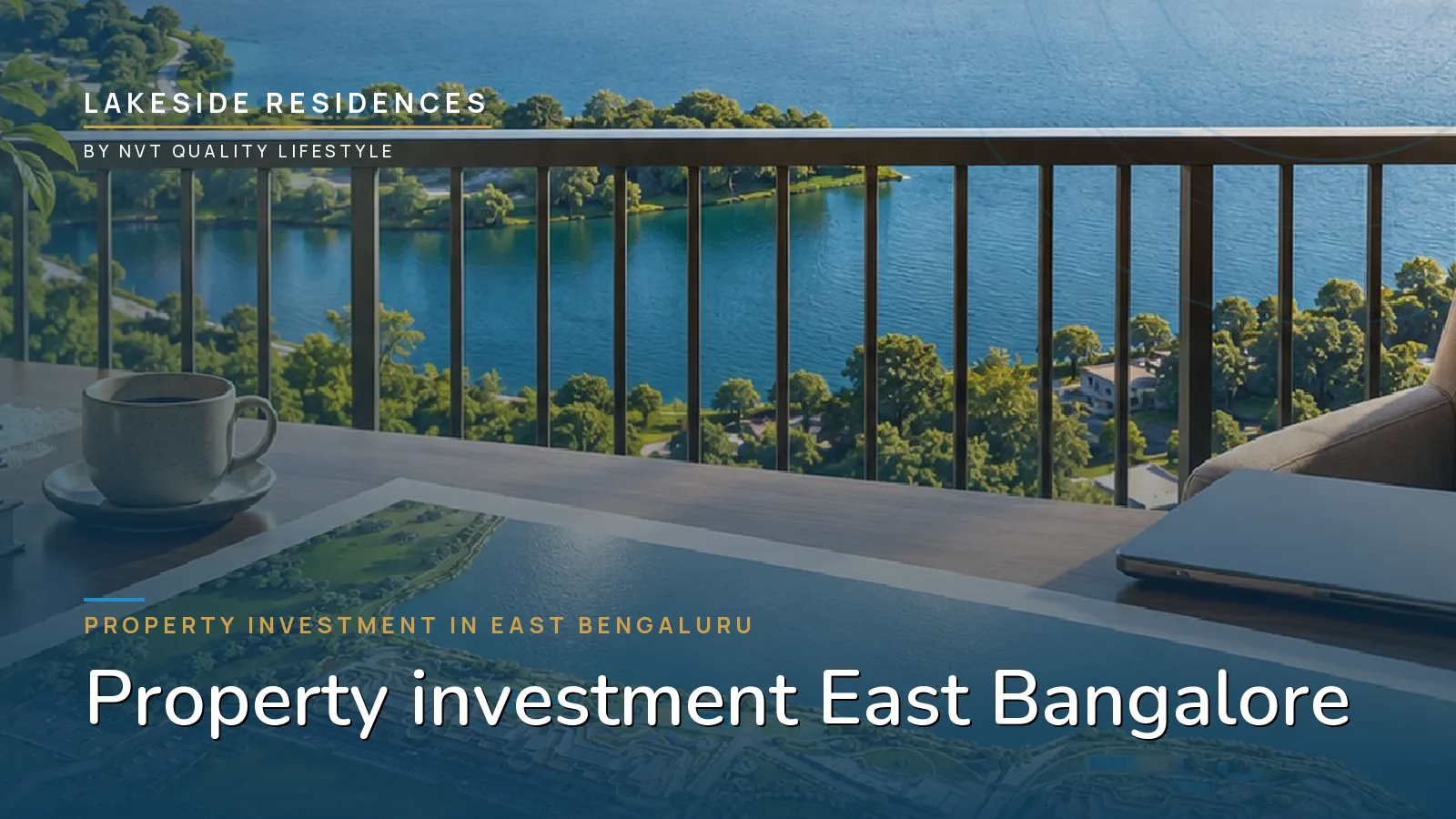
Lakeside Residences is a coming-soon project of 604 lake-facing 3 and 4 BHK Sky Villas by NVT Quality Lifestyle, set on 30 acres within a 100-acre integrated township on Sarjapur–Attibele Road. Every home faces a 300-acre lake, four homes share a floor, and there are four dedicated elevators. Indicative starting values run from ₹1.69 Cr for the Large 3 BHK to ₹2.68 Cr for the Prime 4 BHK, on a base price of ₹8,999 per sq ft. The project overview and the price guide carry the detail.
Why those specifics matter to an investment case rather than just a lifestyle one. Four homes per floor is a scarcity argument that holds even when the surrounding belt builds more. A lake outlook is a differentiator that cannot be built next door, which is unusual in a corridor where most new supply looks inward at a podium. And a 100-acre township can support an amenity base that a standalone tower cannot fund.
The project's own material carries an estimated residential-project appreciation of about 25% between 2025 and 2028. That figure is the developer's projection, not a promise, and it is the only forward-looking number worth reading closely. Read it, then discount it for every year that passes without the surrounding infrastructure being delivered.
An investment case is also incomplete until you can describe who buys the home from you. In this corridor that buyer is usually another end user, often a senior professional working in the southern IT belt or the Attibele industrial area, looking for space and a view rather than a small unit close to a station. That shapes two practical decisions: size and format matter more here than in a rental-led micro-market, because a large lake-facing home competes against very few alternatives, and the exit is easier when the address is legible to a buyer who has already heard of the road.
What to verify before you commit
- The K-RERA registration number is not yet published. Ask for it when it is issued and check it yourself on the Karnataka RERA portal.
- No possession date has been published either. Treat any verbal timeline as indicative until it appears in a registered document.
- Areas and starting values are indicative and will be finalised with registration.
- The starting value includes one car park. It does not include clubhouse membership, infrastructure charges, maintenance and corpus charges, floor-rise charges, PLC, SDR or applicable GST.
- The interest form records your preference. It is not a booking, an allotment or an agreement for sale.
The apartment buying checklist walks through the rest of the paperwork, and the buyer guides under guides cover stamp duty, home loans and RERA checks separately.